I enjoy reading about UFOs.
That statement tends to make people sort you into one of two categories immediately. Either you’re a true believer convinced that aliens are visiting Earth, or you’re a skeptic waiting to explain every sighting away as a weather balloon, Venus, or an aircraft seen from the wrong angle.
The problem is that both sides often seem more interested in defending a conclusion than exploring a mystery. If you suggest that a sighting might have an unconventional explanation, some people assume you’re advocating extraterrestrials. If you suggest a natural explanation, others assume you’re dismissing the witnesses.
I’ve always found the space between those positions far more interesting.
When I read about a UFO report, I’m usually not asking, “Was it aliens?” I’m asking a different question: If we accept the observations at face value, what other explanations might fit?
Not explanations we can prove. Not explanations supported by hard evidence. Just possibilities that are no more extraordinary—or any less established—than the assumption that an advanced extraterrestrial civilization happened to stop by for a few minutes.
Sometimes it’s simply fun to explore an alternative theory that takes the witnesses seriously while also avoiding the immediate leap to alien spacecraft. One of my favorite examples is the famous 2006 O’Hare Airport sighting.
The O’Hare Incident
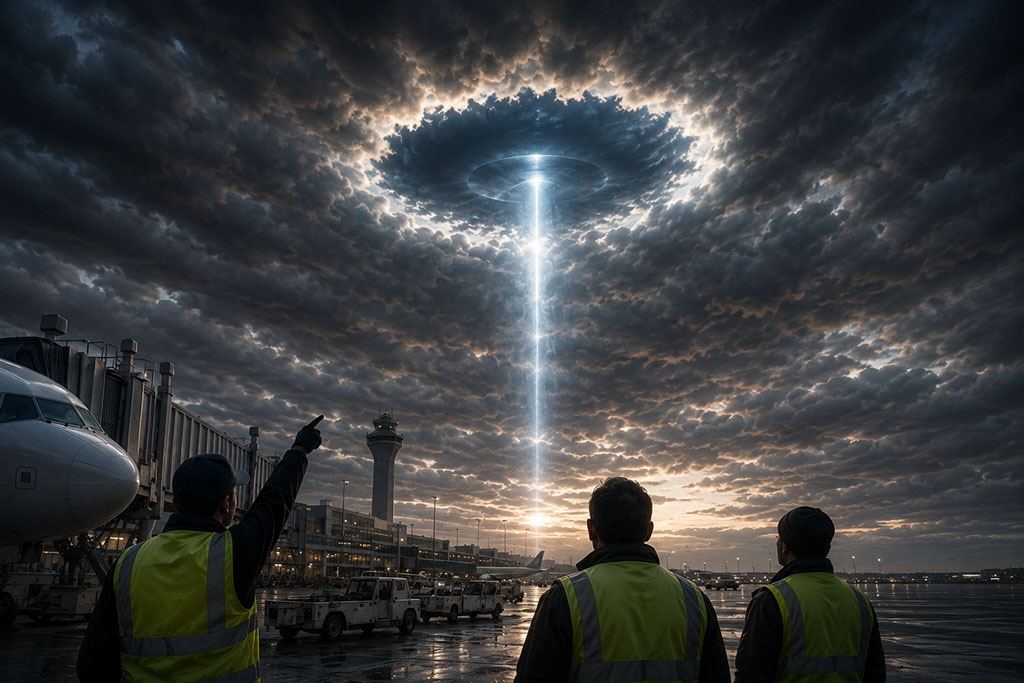
On November 7, 2006, multiple United Airlines employees reported seeing a metallic, disc-shaped object hovering over Gate C17 at Chicago’s O’Hare International Airport. The witnesses included ramp workers, mechanics, supervisors, and at least one pilot—people who spend their working lives looking at aircraft and the sky around them.
According to the reports, the object hovered silently for several minutes before suddenly accelerating straight upward and punching a clean circular hole through the cloud layer overhead. The hole reportedly remained visible for some time before gradually closing.
The sighting gained national attention and remains one of the more intriguing modern UFO cases because it combines several characteristics that are rarely found together: multiple witnesses, aviation professionals, daylight conditions, a prolonged observation, and a dramatic physical effect in the cloud layer.
The official explanation focused on a weather phenomenon known as a hole-punch cloud or fallstreak hole. Such formations are real and well documented. But some aspects of the case have always felt slightly unsatisfying to me, particularly the relationship between the reported object and the appearance of the hole itself.
Most explanations attempt to explain the hole and then explain the object. What if those were never two separate events?
A Different Possibility
What follows is a thought experiment.
Imagine that a narrow filament of solar-derived plasma or charged particles somehow becomes guided through Earth’s magnetic environment and ultimately couples into a small region of the lower atmosphere. Not a broad solar storm. Not a regional geomagnetic event. A localized, coherent filament.
The Sun constantly produces enormous amounts of energy and plasma. The challenge is not generating the energy. The challenge is concentrating it. Instead of thinking about a beam of light, imagine a temporary plasma structure guided by magnetic fields—something analogous to a field-aligned duct or flux tube.
In this model, the Sun supplies the energy, Earth’s magnetic environment supplies the guide rail, and the atmosphere supplies the screen on which the effect becomes visible.
Whether such a phenomenon actually exists is unknown. The point of the exercise is simply to ask what might happen if it did.
The Hovering Disc
The cloud ceiling that afternoon was reported at approximately 1,900 feet. As the filament interacts with a small portion of the cloud layer, it begins depositing energy into a localized volume of air.
The effect is initially subtle. A pocket of air becomes warmer than its surroundings. Changes in temperature produce changes in density, and changes in density change the way light moves through the atmosphere.
The result could be a powerful localized optical distortion. To observers below, that distortion might appear darker than the surrounding cloud deck. It might exhibit sharp boundaries. It might even produce the appearance of a reflective metallic surface.
In effect, the atmosphere itself becomes an optical device.
People standing on the tarmac wouldn’t see heated air. They would see what appears to be a solid object. Once radio chatter begins and multiple observers start looking in the same direction, the human brain naturally tries to identify what it’s seeing. Faced with a visual phenomenon unlike anything in normal experience, witnesses describe it the only way they can: a metallic disc hovering in place.
Importantly, this explanation does not require anyone to be mistaken, dishonest, or irrational. The witnesses accurately report what they observed. The interpretation of what caused the observation may simply be different from what it appeared to be.
The Hole in the Clouds
As energy continues to accumulate, the interaction with the cloud layer intensifies and cloud droplets begin to evaporate. The clearing process starts in the upper portion of the cloud layer and gradually works downward.
From the ground, little appears to change at first. The cloud deck still looks intact. Then, suddenly, the clearing reaches the bottom of the cloud layer and a circular opening becomes visible.
To an observer watching the dark disc, the timing would be dramatic. The object appears to shoot upward. A hole appears exactly where it had been. The mind naturally links those two observations into a single event: the object accelerated upward and punched through the cloud deck.
But in this scenario, nothing actually departed. The optical distortion vanished at roughly the same moment the clearing became visible. The apparent motion is created by the sudden change in the visual field.
The disc and the hole are not two separate phenomena. They are two stages of the same phenomenon.
Why This Idea Appeals to Me
Not because it explains the case, but because it attempts to treat all of the observations as potentially meaningful.
The hovering period, metallic appearance, sudden ascent, hole in the cloud layer, and absence of radar returns are all treated as relevant pieces of information rather than inconvenient details to be explained away. Instead, the theory attempts to account for them through a single underlying mechanism.
Whether that mechanism is correct is secondary. What interests me is the possibility that there may be categories of atmospheric or solar-terrestrial interactions that we simply haven’t identified yet.
History offers numerous examples of unusual observations being reported long before science fully understood them. Ball lightning, sprites, blue jets, atmospheric ducts, and various optical mirages all existed before we had satisfactory explanations for them. People often observed the phenomena first and developed the explanations later.
That doesn’t mean every UFO report is hiding a new branch of physics. It does suggest that the universe occasionally turns out to be more creative than our existing categories.
The Real Point
The most interesting aspect of the O’Hare case isn’t whether the object was extraterrestrial. It’s that credible witnesses observed something that didn’t fit their experience.
When aviation professionals repeatedly say, “It wasn’t any of the things we see every day,” that’s useful information. The question is what we do with that information.
Too often, discussions collapse into a false choice: either the witnesses misidentified an ordinary phenomenon, or aliens visited Chicago.
Those aren’t the only possibilities.
There may be an enormous amount of unexplored territory between conventional weather and extraterrestrial spacecraft. The O’Hare case reminds us how little we sometimes know about the interaction between light, clouds, plasma, atmospheric conditions, and human perception.
My hypothetical plasma-filament explanation may not be the answer. But I think it asks a worthwhile question: What if the witnesses accurately described everything they saw, but the phenomenon itself belonged to a category that nobody has identified yet?
That’s the space I find most interesting. Not certainty. Not belief. Curiosity.
What do you think? Have you encountered other sightings where an atmospheric, optical, or plasma-based explanation might account for the observations? Or do you think cases like O’Hare still point more strongly toward some form of advanced technology—human or otherwise?
I’d love to hear your thoughts.